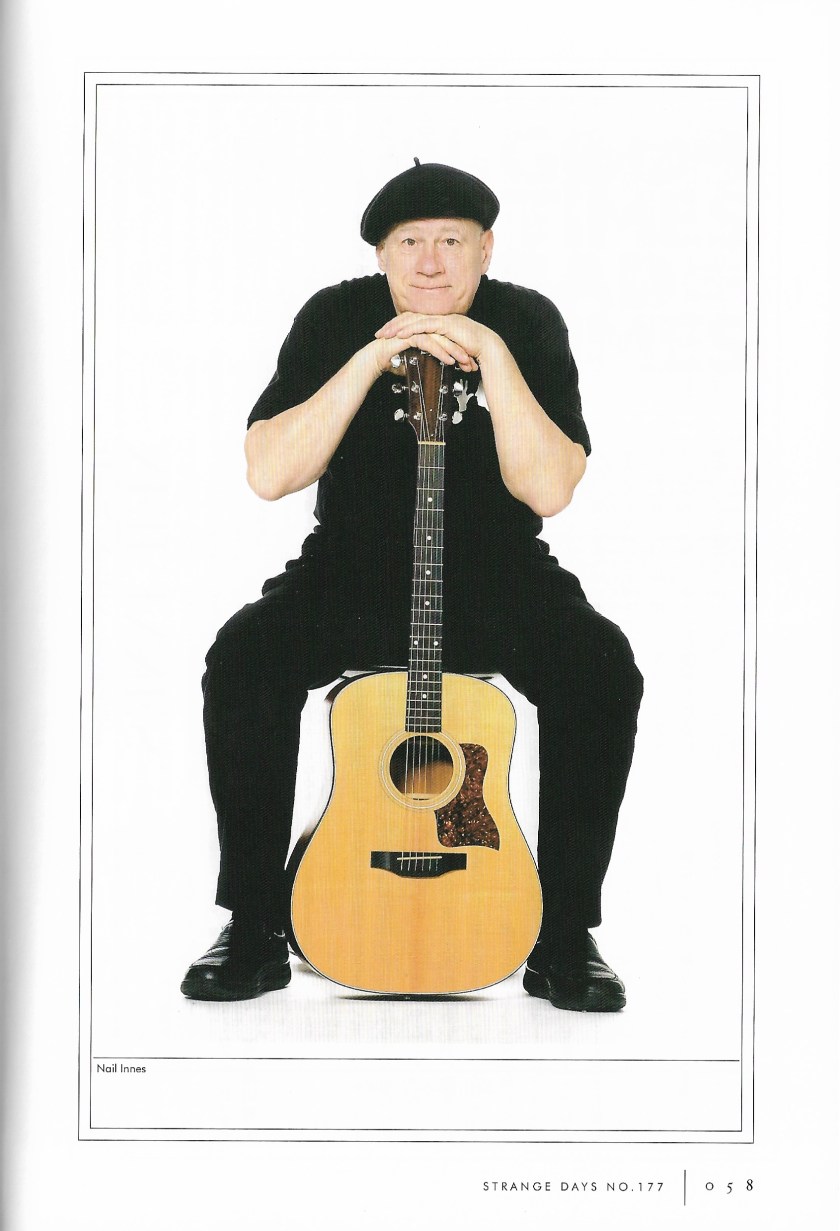
The world needs an idiot with a duck on his head and a piano: Neil Innes R.I.P.

I have just been told that Neil Innes is no longer with us, and I am totally devastated by this sad news. Could 2019 end much worse than this? I am not sure. What the world desperately needs right now is an idiot with a duck on his head and a piano.

Neil Innes has been called Monty Python’s songwriter – and you may remember him as the leader of Sir Robin’s minstrels in ‘Monty Python and the Holy Grail ’ – as well as Ron Nasty (in parody of John Lennon) in the Rutles.

However, for me, the Rutles were a great pop band more than anything else. And Innes wrote all their songs.

He was famously sued by the owners of the Beatles’ catalogue, lost the case and had to share songwriting royalties with them. But the testimony, based on minute scrutiny and comparison of the songs, actually cleared Neil Innes from plagiarism, technically speaking. Maybe the owners of the Beatles’ catalogue followed through with the lawsuit because they feared Innes’ originality more than anything else?

In memory of this great man, here is my interview with him. It was originally published in Japanese music magazine Strange Days #177, pages 57-63, August 2014.

.Neil Innes p57

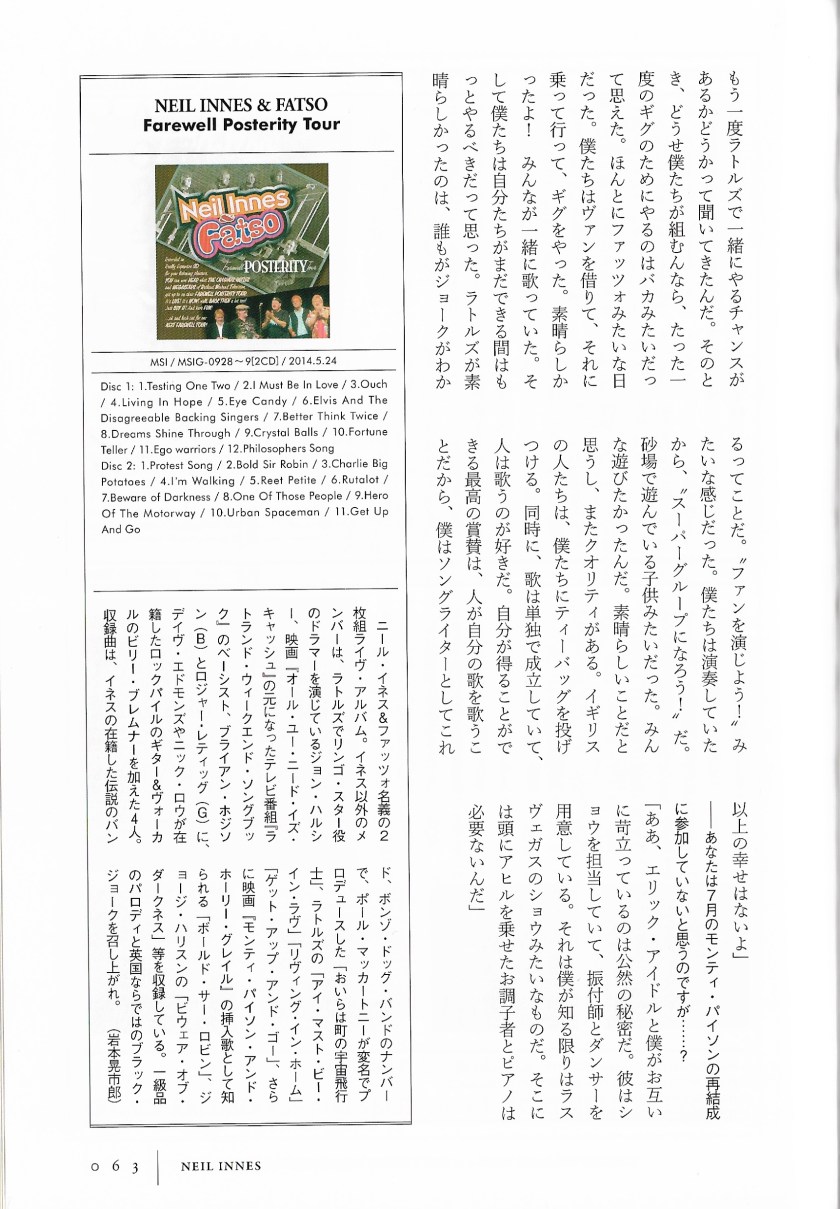
Although Neil Innes has reached the respectable age of 69, he has a new Posterity Tour album with Fatso, a box set on his new So There label compiling all the Recollections CDs and is touring with the Rutles. On top of that, he is also busy composing his audio memoirs. That is a lot of activity for a man who confesses to have no more ambition as he has already been impersonated by Elvis Presley.

At the end of our chat, Innes says: ”There is no need for an idiot with a duck on his head and a piano.” Nothing could be further from the truth!


Fatso was in fact the original Rutles band. How did that come about?

Innes: I was making the TV show Rutland Weekend Television together with Eric Idle when drummer John Halsey rang me up and told me he was playing with this fantastic band. And I said ”Oh, you lucky thing. I’d love to go out and play live. This television is all very well, but it’s… you know, television.” So he asked me to come and play with the band.

They played in a pub every week, and I started going there. We had these little amplifiers, a very tight band and a lot of fun. One night Eric Idle and George Harrison turned up to see us, and Fatso then became the Rutland Weekend Television band.

We all drifted apart when Rutland Weekend finished. I had other things to do… and then we had the reunion tour a couple of years ago, the posterity tour, because we wanted to get together again! Roger Rettig is living in Florida and Billy Bremner is living in Sweden, so it was complicated, but Brian Hodgson got the tour organized.

Neil Innes p58

Did he also make a nicely painted bus available for the tour?

Innes: Ha ha, no, that happens in films!


The Rutles originally appear in a sketch on Rutland Weekend Television where you treat people against love by giving them sex…

Innes: Rutland was the smallest county in England, and the theory was that it would have the smallest television station with not much money. So all the jokes in Rutland Weekend Television were quite cheap. Since a ”A Hard Day’s Night” was black and white, sometimes speeded up, and looked like very cheap to make, I had the idea to make a parody of it. I had written a song called ”I must be in love” and Eric Idle had this sketch about a man suffering from love and an idea about a film maker who was so dull the camera would run away from him. In Eric’s mind he made the song start with me in pajamas being in hospital. We recorded the song, with Eric and another actor, David Battley. So you didn’t see Fatso in the film, you only saw John Halsey and myself.


But Fatso were playing the music?

Innes: Yes, absolutely. In fact, George Harrison liked that version more than the later one!


That episode was then shown by Eric Idle on the Saturday Night Live show in the US, and the idea came up to do a film. And you were asked to quickly do a bunch of Rutles songs.

Innes: I made two good decisions on the Rutles thing I think. One was not to listen to any Beatles songs at all when writing. Instead, I tried to remember where I was when had I heard them. For some of the early ones, I was still in school, about 16 or 17. For songs like ”Hold My Hand” I went back to those days, and thought about how relationships with girls were like and how exciting it was to put your hand in a girl’s bra. So those songs have an innocence to them.

The more psychedelic songs had to have another kind of discipline, where you can’t write any old rubbish. I knew I didn’t want to trivialize any of the Beatles songs, they are too good and I am not going to go for cheap laughs. I’m going to go for something that is… not as good but maybe equal in another way. Give the songs the respect they deserve.

And the second thing was to get Ollie Halsall, Ricky Fataar, John Halsey and myself living together very quickly as it were. We had this house in Hendon were we just rehearsed for two weeks. After the two weeks we were really tight as a band, and we went in the studio and made the whole album in ten days. The album only took ten days, including the orchestras and the overdubs and the mixing.


Fantastic. And I suppose those rules also eventually got you out of court?

Innes: No, there was no court, it was the bully boys. ATV Music, who had Northern Songs, had a million dollars put aside for any kind of Beatles song infringement and reacted when there were 14 songs on the album – they weren’t interested in the six that were on the film. They were saying outrageous things like ”Hold My Hand” was like ”Back In The USSR”  and ”Twist and Shout” which is the funniest thing because the Beatles didn’t write that!

My publishers said they would fight it. They got a musicologist for $5500 which was a lot of money back then and he answered all the things: ”The lyrics are different, the tune is different.”

But then the big reality thing came in, and ATV said they would take it to court anyway. My publisher suddenly realized that even though they would win, they might not get costs – and they weren’t going to risk that. They then settled out of court, very badly, and I was abandoned, really.

Neil Innes p59

Your new ”Farewell Posterity Tour”  CD, showcases five different Neil Inneses: The pastiche Neil Innes on tracks like ”Living In Hope”, secondly the pastiche that itself turns into a pop classic, like ”I Must Be In Love”, ”Doubleback Alley”, ”Cheese and Onions” and so on. The third Neil Innes is the 7th Monty Python, like on ”Elvis and the Disagreeable Backing Singers” and ”Protest Song”. The fourth Neil Innes is the straight cover artist, where you do ”Beware Of Darkness” in a really really nice way. And finally the fifth one is the pop genius in his own right, with ”Dreams Shine Through” and ”Urban Spaceman”.

Innes: All I can be is myself, even if I am five of me! Never mind the 7th Monty Python, I am the 5th Neil Innes!

In the Bonzos days we were free, we did what we liked. Music is about humanity more than anything, it’s about what it’s like to be alive. And it is not about politics, categorizing or making an ordered world. So I don’t see why you can’t write a song about anything. Shakespeare wrote dramas and comedies. If he was allowed to do it, why can’t I? So I say I do what Shakespeare did, only with better songs!!

When I was doing a one-man show, I went to this place in the middle of England, called Corby. It was a dull wintery day, drizzling with rain when I came to the theatre. And as I drove up, it said: ”Tonight: Neil Innes, Comedian?” Question mark. That sums me up!


I’ve suffered for my jokes, now it’s your turn!

Innes: Yes, ha ha!

Neil Innes p61

Now you have left posterity behind you and are focusing on new things?

Innes: It is very tempting to never do anything again. Late last year, a friend of mine who is writing a book on Elvis Presley e-mailed me and told me that Elvis had his own cinema, at enormous expense, and that his favourite film was ”Monty Python and The Holy Grail.” Apparently, he knew every word and could do all the voices. That makes me one of the few people on the planet to have been impersonated by Elvis Presley! It is not the other way around! So, I have done it now! I’ve got no more ambition!

But I am still very busy, because I am doing sort of audio memoirs now, mixing music and stories and things like that. Again, it is not for a mass audience release or anything in particular. The working title for this memoir is Radio Noir. Radio noir like film noir, only it is really a metaphor for the human brain. Here we all are with our little brains on top of us, and we don’t really understand anything. We know a lot, but the more we know, the less we understand it seems. Certainly in my case!


You have also formed your own record label So There.

Innes: Yes. I think it is probably the only way you can manage. The big record companies are… well, it is organized crime. It’s not disorganized crime, it is organized crime.

I have actually sent notice to Sony who took my Rutle songs and in America after 35 years you can have the copyright revert to you. I have done that. It is only in America, but I am making my point. That is all you can do, as a little person in this world. Not be forced around by bullies,.


On So There you have released a Le Ducks box of ”Recollections.” There is a DVD with Innes Book of Records clips. Do you own the copyrights to the Innes Book of Records series then? 

Innes: The DVD that is in the box set is not for sale. You buy the records and this is stuff that is out there in the public domain because people have put it out there. But we have got the very best prints we could find, so the quality is really quite good.

In fact with So There, we are looking to put out the full series, and the BBC are going to give us everything. But since we made this program with ordinary people it is difficult to contractually clear a DVD sale. I don’t know how we are going to do it, but we will try.


”Recollections” is now a Le Ducks box set. What is the cultural meaning of the duck?

Innes: Well, it goes right back to the Bonzos. I wanted to be a superhero called Alias Normalman, and I had my tights and my t-shirt saying Alias Normalaman. But I didn’t have anything to finish me off, you know for head gear. I was in Woolworths, and in the toy department there was a row of these giant yellow ducks on wheels. You pulled them along on a string and if you squeezed them, they quacked. For some reason, I just looked at one of them and realized that I had never seen a duck that big. If I cut the wheels off, it would make a hat! Then, when I wrote ”How Sweet To Be An Idiot”, I thought that would be another time to wear the hat. Since then, I’ve never been allowed to forget the duck!


You have a duck and Kevin Ayers had a banana and both of you played with Ollie Halsall.

Innes: Ha ha ha! I played with Kevin Ayers on a couple of gigs! And with Ollie of course. Ollie was absolutely fantastic. I wonder sometimes if he was not maybe autistic in the sense that people with autism are sometimes much more brilliant at one thing. And as a musician, he was just uncanny, he was an acrobat. 

Neil Innes p62

Now you are touring again with the Rutles. How did that come about?

Innes: Last year in August, Bill Heckle at the Beatles week in Liverpool, asked me on the phone if there was any chance in getting the Rutles back together again. Once we got it organized it seemed silly to do it for just one gig. It was like Fatso days really, we hired a van and got in it and went in and did these gigs. And it was great! Everyone’s singing along. And we thought that we should do more of it while we still can.

What was nice about the Rutles is that everybody got the joke. It was like: ”Let’s play fans!” Because we were playing: ”Let’s be a super group!” It was like children playing their games in the sand pit – and everybody wanted to play. I think it’s lovely and it’s still got that quality. People in England throw tea bags at us. At the same time, the songs do stand up in their own right and people like to sing them, and as a song writer I couldn’t be happier because the best praise you can have is for people to sing your songs!


I suppose you will not be appearing at the Monty Python reunion in July?

Innes: No. It is an open secret that Eric Idle and I have drifted into mutual irritation. He is in charge of the show, and he’s got choreographers and dancers, it’ll be more like a Las Vegas show as far as I can see. There is no need for an idiot with a duck on his head and a piano.

Neil Innes p63

Almost forgotten: 10 best albums of Q4, 2019

Roger Heathers - Grim

Listing the best albums of the fourth quarter of the year is always very difficult. Everyone is focused on summing up the year and competing to get their overviews and best-of lists out before everyone else, a lot of great music released in Q4 tends to get lost by the wayside. I have sinned as well, inasmuch as I published my best-of-the year list already two weeks ago.

But the fact reamins that there are were many sublime albums also this quarter that didn’t make it into that list. So in order to rectify at least a little, here is my list of favourite albums for this ugly duckling of a quarter. 

And, honestly, every album here is really and truly worthwhile!!  This may be the last quarter of the decade, but it certainly goes out with a bang!


William Doyle – Your Wilderness Revisited

An album that takes the electronic pop that Doyle has been exploring in East India Youth to the next level. Great melodies combined with a reflective exploration of the fabric of places, or maybe even more the fabric of experiencing places. thoughtful and hummable in equal measures – and with Brian Eno guesting! 


Feet – What’s Inside Is More Than Just Ham

Billed by some as the future of British pop, this album kicks off in a magnificent way with irresistible opening track ‘Good Richard’s Crash Landing’ that merges Gorky’s Zygotic Mynci with Syd Barrett. The rest of the album is pretty great too, and wonderfully wacky, although not all of it gets me into the future. Still, an incredibly promising start, can’t wait to see where their silly feet will take them next!


Jake Fletcher – Jake Fletcher

I just don’t get people who launch albums in the second half of December, when everyone has already written their pieces wrapping up the year. Here is a bona fide tour de force singer-songwriter album, all quirks and great melodies, that will just disappear, I am afraid. Don’t let that happen! Pick this one up!!

https://www.youtube.com/watch?v=KYl77a3KnMo


Ham Legion – Paradise Park

This was part of my my best of 2019 list, and i stand by every word I wrote there: Here’s an album full of power chords and metally, growly things that simultaneously dares to be light as a butterfly. The effect is stunning in a literal and visceral way. Now this list is in alphabetical order, but if I were to pick a second album of the year, this is clearly it.


Roger Heathers – GRIM

Roger Heathers is a very productive pop musician, both solo and as part of Pea Green Boat. Only this quarter he has released a string of Pea Green Boat singles and two solo albums. Although I think Roger might still gain from focusing a bit more on honing his releases, the fact remains that everything he puts his hand to comes out very nicely. Think intelligent 70s pop with beautiful multilayered voices and a modern sensibility. Check out his latest one as well, ‘How Sweet!’ because it really is!


The Leaf Library – The World Is A Bell

You might frown at this and call it repetitive or think of it as mesmerising and hypnotic and lap it up right away. For me it is a bit of both, but when I am in a reflective mood for it, this works much better than any music labeled ‘ambient’. Given the slighlty glacial pace yet busy and classy production, as well as the fact that it is all wrapped around a beating pop heart makes it difficult to not think Stereolab, although this sounds quite different.

And if you want to experience the deep end of The leaf Libary, they have also released a half-hour minimal drone piece as a name-your-price download this quarter. Not for the faint of heart.


Anna Meredith – Fibs

The genre hopper badge of the year should definitely be given to Anna Meredith. here she covers all bases, from film music via various kinds of popular music to jazz and classical. Yet it is all tied together into a visionary stab at trying to take music forward, to discover something new and exciting. She might not yet be breaking free from the avant garde, but she is well on her way. Wonderful!


Sean O’Hagan – Radum Calls

Another album that was already listed in my best of 2019 list, and if anything I like this album even more now than I did only a few weeks ago. Anyway, this is what I wrote then: While only being Sean’s second solo album proper, this builds very much on his long raft of High Lamas albums. A brilliant return – and a bold step forward for experimental pop music.


Vinny Peculiar – While You Still Can

Potentially the least peculiar album that Vinny has made in quite some time. Instead full of really great songs and obeservations. Highly recommended.


Wilco – Ode to Joy

I must admit that I have never been much of a Wilco fan, but this new album is just plain wonderful. Stripped back and simple, yet with a warmth and sense of volume that just pulls me straight in. Are all the other Wilco albums this great if I give them a better chance? 

Gentle Giant release insanely giant box

Clocking in at 29 CDs plus one Blu-ray, the ‘Unburied Treasure’ box set by Gentle Giant is truly insane. But given that this band made insanely unique music, it is only fitting. The short of it is that I would recommend this box to newcomers and long-time fans alike, but if you need more convincing before shelling out what might also be seen as insanely much money for CDs in this day and age, then read on.

Gentle-Giant-box-photo-square-1500

When the end is a new beginning

With 30 discs in total to choose from, I am probably the only reviewer to dive directly for the June 16 1980 live set recorded at the Roxy in LA.

I fumble when trying to press the disc onto the spindle. But then, finally, it is there. ’Convenience (Clean and Easy)’ from final Gentle Giant album ‘Civilian’ blast through the speakers and it takes less than a minute for my eyes to fill with tears.

But wait a minute, that final album is crap, right? Well-known prog rock journalist Sid Smith recently asked his Facebook friends the following: “I’m writing something about when our love for an artist cools or dies completely. 

What LP caused you to part company and why? How did you feel? Was there ever a joyful reunion?”

‘Civilian’ by Gentle Giant was one of the answers he got.

And despite the members of the band defending the album even today, all I hear is a mediocre stab at mainstream 1980s rock.

The reason I am putting on this particular disc is that for more than 39 years I have believed I saw the last ever performance by Gentle Giant. That concert took place at the Old Waldorf in San Francisco on June 15th, and I specifically attended the second set starting at 11 PM, because in the tour program published at the time that was indeed the very last.

Turns out I was wrong.

Turns out they added added the Roxy in Hollywood for two more shows even though they had been there the night before the Old Waldorf, due to popular demand.

Turns out that I have even have that performance on CD already, as it was previously released as ‘The Last Steps’ in 1996; it has just been mislabeled as the ‘official’ June 14th show all these years. Probably by someone like me who had seen the originally published tour schedule.

So, one more childhood illusion shattered. Anyway, I was there at what was then the penultimate night (sigh). 

The Old Waldorf was a small venue, holding only a couple of hundred, a club with tables, creating a very intimate setting. I remember the band actually announcing that it was their last performance there on that stage (despite what then happened the following night), and there was a shock of sadness like a ripple through the room.

But they certainly went with a bang. Wow, what an emotional show!

They mixed songs from the ‘Civilian’ album with a selection from their classic albums, while they showing off their incredible musicianship by swapping instruments with each other seemingly at random during the show. And organically that led up to everyone playing their otherwise also well-documented all drums number.

Much of that can be heard on this final disc, although the sound quality suffers from having been recorded at such a small venue. I haven’t been to the Roxy but understand that it was similar to the Old Waldorf – it certainly sounds like a club recording and doesn’t breathe. As a result, the excitement I felt at seeing them unfortunately doesn’t translate onto disc.

One of those “you had to be there” moments.

From one extreme to the other

From that extreme end, the next disc to get a spin is from the very beginning, because, excitingly, we have full Steven Wilson stereo and surround remixes of the magnificent first Gentle Giant album from 1970. 

In 2017, Alucard released the ‘Three Piece Suite’ containing new mixes of a few tracks from each of the first three albums. To my knowledge, they did so because the other master tapes were lost. So, had they now found the missing masters? 

On re-reading the ‘Three Piece Suite’ liners, I realise there is no mention of lost masters; there is in fact no real explanation for combining the three first albums into one at all. Hmmm…

In fact, despite all the books, and posters and stuff that you get with ‘Unburied Treasure’ there is no explanation here either. There are in fact no mentions about the remixes at all. Very irritating.

In any case, I put on the surround mix first. And boy, does that translate to disc, just wow! 

‘Gentle Giant’ is in places rather sparse in its instrumentation and quite gentle indeed, leading one to think that doing a surround mix would be overkill. Nothing could be further from the truth. Instead, this mix shines light on all the nuances and magically enhances the multi-vocal parts. In fact, I think it is one of the most impressive surround mixes of 70s records I have heard – and I have heard many. 

Even in the prog rock genre, Gentle Giant’s music is effortlessly at the top when it comes to complexity, yet they are simultaneously the most melodically oriented of them all. In that sense, Gentle Giant are to prog rock what 10cc are to pop music. As a result, their music is a natural fit for surround. 

But having said that, I was not prepared for the depth such a mix would reveal in their debut album. Totally fantastic! If you are a hard core Gentle Giant fan, I would say that this mix alone is worth the (very high) price of this box alone.

The perfect middle ground

After the end and the beginning, I go smack bang to the middle since the 1975 album Free Hand is my favourite after all. For this reason, it is a great pleasure to find a classic concert performed in the wake of the release of that album here, namely in Basel on November 24th. Although there Is a professionally recorded (and filmed) performance from Germany on August 10th previously released as the ‘Giant on the Box’ DVD, this sadly seems to be the only other recording from that phase. And, it is brilliant, with engaging performances, the trademark taped breaking glass intro to ‘The Runaway’ that has the audience clapping hands before the strange time signatures quickly overwhelm them, a spinning coin introducing ‘Excerpts from Octopus’ and all in quite good sound quality. A must hear! 

Digging in

There are many other live discs here, from every phase of the band’s career. I can’t say that I have fully listened to them all yet, but at an attempted quick skip through listen I got caught up in the music on too many occasions making it a very long listening session indeed. 

Despite heavy touring as can be studied in detail in the included LP sized 97 page ‘Tour History’, Gentle Giant only released one live album, ‘Playing The Fool’. Given their incredibly high musicianship, it is not surprisingly the highest rated Gentle Giant album on progarchives.com, even though the band were beyond their peak creatively speaking. But here, for the first time, we are treated to the complete set of recordings that were used as the basis to compile that album. Although some of it has been released in bits and pieces here and there, it is great to have it all, not least because it represent the most well recorded live material they ever did – and they are indeed in blazing form throughout.

Other notable inclusions on the box are a great BBC session from 1972, lost from the BBC archives but taped off the air by a fan, and the Pinewood Studios rehearsal tapes prior to setting out on a tour of America in 1977 in full remastered (if not exactly glorious) quality. The set contains two songs from ‘The Missing Piece’ album that were never recorded live in any other way – and at least ‘As Old As You’re Young’ is every bit as good as classic era Gentle Giant.

It is easy to gush on about Gentle Giant, but who is this box for?

I really would want to recommend it to someone who is new to the band, or in fact to someone who has now experience of 1970s prog rock at all. Gentle Giant suffer from none of the pomp or pretentiousness that prog is often, and partly correctly, associated with. Instead they showcase musical invention and team spirit at its best. But would such a person shell out well above £250 for a box like this? I wonder… 

Blu-ray box next please!

So that probably leaves us to the committed fans instead. But they probably already have multiple copies of all the official albums. I had much rather seen a complete Blu-ray release of the studio albums instead, to be honest. Since ‘Acquiring the Taste’ and ‘Three Friends’ were not remixed for this release, will we they ever get a release? Although this box it is certainly great not only in its physical shape and form, I hope it won’t be the last.

So far, only ‘Octopus’ and ‘The Power and the Glory’ are available in proper, uncompressed surround editions, despite the fact that no other band I can think of, including King Crimson, gains as much from surround mixes. 

Even though surround mixes of both ‘Free Hand’ and ‘Interview’ exist, they have only been released as compressed DTS versions on that awful DVD-Video disc format. Even just thinking about a surround mix of the insanely intense experimental masterpiece that is ‘In A Glass House’ makes my mouth totally dry. How on earth hasn’t that even happened yet!?! Just asking! After all, that first post Phil Shulman album is the point were the band really should have dropped the ‘gentle’ part of their name, as what followed were quartet of albums deceptively still full of gentle sounds but at heart utterly without compromise.

In comparison, ‘The Missing Piece’ obviously would pale, but it is still a great album, and surely the master tapes at least for that album are still around?

Unlike other progressive acts from the 1970s, Gentle Giant have never reformed. As an effect, their singular legacy remains fully untarnished. And these guys truly were giants although they lost their way with the two last albums. The taller they are, the harder they fall.

That is why this box is essential. Yet we still want more!! Blu-ray box next please!

Roy Wood cuts the mustard

ROY-WOOD-720x720

In an extremely crowded field of English eccentric pop stars, Roy Wood still stands out with ease. He is very consistently strange, in a Vivian Stanshall kind of way. 

Since his time with the Move, he has been as comfortable with writing charting pop hits as with doing over-produced doo wop pastiches. And in the process he has probably managed to alienate both the hit listeners and the Americana aficionados.

Given his incredible talent and musical skill that is no mean feat. It is of course also a terrible shame.

Because, just like his one time band mate Jeff Lynne, he really has total mastery of the beatlesque pop song formula. You get the impression that he can bang out a tune that appeals equally to your feet and to your brain almost without any effort at all. Simultaneously, listening to his albums also becomes an exercise in patience since he has a tendency to fill the spaces between those irresistibly stellar pop songs with homages to 1940s swing era or rock’n’roll medleys.

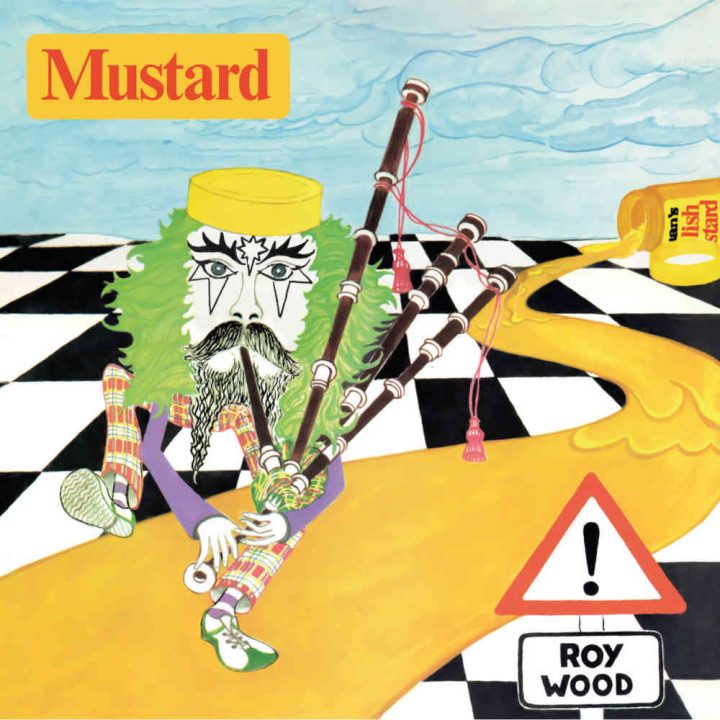
That is certainly also true for his second solo album, ‘Mustard’, from 1975, which is now it is being reissued by Esoteric in remastered form. Unfortunately, the bonus tracks are the same ones as on the Edsel edition from the late 1990s and the Japanese reissue from 2006 on Air Mail Archive: Given that Roy not only recorded this completely with only the slightest of vocal help (from girlfriend Annie Haslam among others), but also had to movie studios in the middle of everything, resulting in a quite protracted recording period, I am sure that there really is a ton of unused material tucked away on a tape reel in someone’s attic somewhere. 

The first bonus track here, ‘Oh What A Shame’ was the last Roy Wood song to bother the charts. Although released in anticipation of ’Mustard’, it is not included on the album – an album that marked the fading away of Roy Wood from the public eye, even though he remained active in some form for more than another decade with his last solo album ‘Starting Up’ being released in 1987.

And listening to ‘Mustard’ now, it is easy to understand why it didn’t sell well. It is really all over the place. 

A needle violently hits the run-in groove of a 78 rpm disc, as the album kicks off with Roy expertly mimicking a 1940s swing tune on ‘Mustard’. It is as skilful as it is flabbergasting. But then on second track, ‘Any Old Time Will Do’ we get a typical Roy Wood pop number, slightly nostalgic and eminently hummable. And on ‘The Rain Came DownOn Everything’ continues with pop drama of the highest order, and comparisons with ELO are not difficult to make.

But then we are back to pastiche land again with the boogie of ‘You Sure Got It Now’, followed by a perfect beach Boys homage in ‘Why Does Such A Pretty Girl Sing’. You just have to roll with it. Granted, even that can be a challenge, as ‘The Song’ comes next, with a plaintive, melodramatic vocal couple of minutes followed by four minutes of romantic, classically inspired instrumental stuff than sounds like it was pulled out of some 50s movie.

Although the 50s touch still very much remains, the next song, ‘Look Through The Eyes Of A Fool’, again pulls us firmly back onto irresistible Roy Wood pop ground. Alas, that bliss is only short lived, as Roy ends the album with an extended potpourri that doubles as a musical workout for good and for bad.

It is easy to be confounded by this record, and it really makes you wonder why at many points.  But simultaneously, it is difficult not to get smitten by Roy’s genuine love for the various genres he visits, and, in the end, to appreciate all his eccentricity. 

Top ten albums of 2019

2019 was a year of climate crisis and political turmoil. Music was just about the only thing that held up a bit of hope, with a flood of stellar albums having been released. Here is my top pick for the year, followed by the runners up in alphabetical order. Included are also my top picks in a few other categories.


Lost Crowns – Every Night Something Happens

In an era where the Spotify business model has transformed the pop song into 30 seconds of content and 3 minutes of hollow repetition, it is ironic that I decided on my album of the year for 2019 after only having heard a few seconds and even though it was the first 2019 album I had heard at all.

Those first seconds contain a sustained, reedy organ tone in the bottom, rattly cymbals and a twitchy guitar on top. That’s all. But in stark contrast to the Spotify template, that intro also promises a journey ahead, a trip into the unknown and unknowable. And ‘Every Night Something Happens’ lives up to that promise.

Album of the year, plain and simple.


Bitw – Bitw

Despite its unassuming home recorded blend of acoustic and electronic instruments and undemonstrative vocals, already the first song hides a huge melody in its guitar lines and an irresistible lo-fi choir.


black midi – Schlagenheim

Sheet music so full of notes that it is beyond the capacity of computers – that is the inspiration for this young London quartet. Cacophonous, manic and frequently quite hard on your ears, while still managing to deliver beautiful melodies and poetic moments.


The Cold Spells – Interstitial

Forlorn and experimentally pastoral post-punk pop. Wonderfully restrained and autumnal, and yes, it does make you think of Robert Wyatt!


Diagonal – Arc

Van der Graaf Generator makes love to Talk Talk and gives birth to ambient prog. This is where post-rock should have gone in the first place.


Ham Legion – Paradise Park

Here’s an album full of power chords and metally, growly things that simultaneously dares to be light as a butterfly. The effect is stunning in a literal and visceral way. Now this list is in alphabetical order, but if I were to pick a second album of the year, this is clearly it.


Jouis – Mind Bahn

Mind Bahn’ starts out with a tape that is quickly wound backwards and leads to the tempered pace of ‘Collapse Rewind’. Although the tempo isn’t very fast, there is immediately a groove that turns out to be a hallmark feature of the entire album. A genuine hippie album for the modern era.


Led Bib – It’s Morning

A free-jazzier take on the North Sea Radio Orchestra. “Spine tingling” wrote North Sea Radio Orchestra collaborator James Larcombe and I can only agree! An easy top pick and another proof that British jazz is back with a vengeance.


Sean O’Hagan – Radum Calls

While only being Sean’s second solo album proper, this builds very much on his long raft of High Lamas albums. A brilliant return – and a bold step forward for experimental pop music.


School of Language – 45

A funk pop concept album from Field Music’s David Brewis, about the ruler of the Untidy State of America. If anything defines 2019, this album is it. Must have.


Best archival issue 2019

North Sea Radio Orchestra – Gap Species

As a kind of prehistory to the NRSO, these tracks mainly date from the period after the demise of the Shrubbies in 1998 and leading up to Craig Fortnam forming the NSRO whose first album arrived in 2006. It holds together very nicely as an album and certainly is no gap filler.


Best reissue 2019

Gentle Giant – Unburied Treasure

Unbelievably massive 29 CD + Blu-ray reissue of one of the cornerstones of 1970s prog rock. Gentle Giant suffer from none of the pomp, gloat or pretentiousness of prog and instead showcase musical invention and team spirit at its best. A band whose reputation only continues to grow, for a good reason. Recommended to newcomers and longtime fans alike! 


Best live album 2019

North Sea Radio Orchestra – Folly Bololey: Songs from Robert Wyatt’s Rock Bottom

I cannot think of anyone better to guide me through the music of Robert Wyatt in this way than the North Sea Radio Orchestra, who in their own music display a similarly English sadness and yearning melancholia. And if you think by now that with a second NSRO album this best of 2019 list is heavily biased towards my personal taste, well then you are completely right!


Best EP 2019

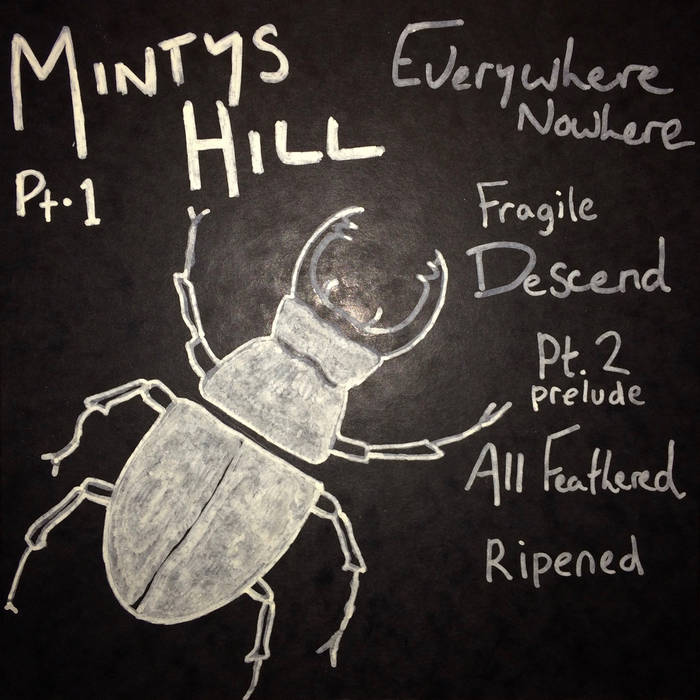
Heavy Lamb – Mintys Hill

Straight out of nowhere comes this cardiacsesque collection of amazing home recordings mixing wonderfully complex melody with walls of distorted jangle. None other than Jo Spratley guests on vocals on the track ‘Fragile’. A debut album seems to be in the works for 2020 – an as of yet unborn contender for next year’s best of list!

Update: This EP was on Bandcamp when I published the list, but has since mysteriously been taken down. Hope you managed to buy it – I did 🙂

a2746169908_16


That’s all, good folks! Now, if I could have one wish for 2020, it is that more musicians get involved in the big political challenges facing us. Back in the 1960s, music was at the center of political change, that was again the case in the late 1970s – and that stage needs to be recaptured in the coming decade!

Take a snap of the Famous Groupies for me

front-cover_orig

When I realised that the ‘Rehearsing The Multiverse’ album by the Famous Groupies is sold through kunaki.com I first thought it might be a project involving David Grahame, the unsung American bedroom pop heir to Emitt Rhodes and Paul McCartney. Listening to a couple of very McCartneyish clips online further strengthened that suspicion.

However, on closer inspection, it turns out that this is the work of other musicians who most likely have been involved in other homage projects in the past.

The album’s first track ‘Don’t Bury Me’ immediately confirms the homage heritage, starting off directly with an obvious reference to ‘Rock Show’ from the Wings album ‘Venus and Mars’ only to segue into a steal from ‘Mrs. Vandebilt’ now transformed into the lyric snippet “please Mr. Macabee”. 

Oh, and the whole song is about Billy Shears, the imaginary Sgt. Pepper’s Lonely Hearts Club Band leader featured on said album, who was then rumoured to be the lookalike replacement in the conspiracy theory about McCartney’s alleged death in a car accident.

https://www.youtube.com/watch?v=nhCE087lVqA

To further obfuscate, the Famous Groupies are said to be a Scottish band, all with the McKenzie surname, who are stuck in some kind of time loop between 1970 and 1976. And this is how bandleader Kirkcaldy McKenzie describes himself: “I co-write and sing the songs. I sing, play guitar, play some piano, play some drums and other various instruments when needed. I am all things McCartney.”

That, by the way, is true of the band name as well, which is lifted from a song on the ‘London Town’ album.

So, with a back story as ridiculous as it is complete, we are almost in Rutles territory here. Apart from the ambitious story telling, what makes it reasonable to talk about Rutles in this context is that the music pulls together bits and pieces of McCartney & Wings material in a similar fashion as Neil Innes did with the Beatles for his Rutles songs; you constantly recognise snippets, but they are skewed out of shape, turned inside-out or put in unfamiliar context. 

As a listener, that keeps you on your toes, feeding you a constant stream of almost deja-vu like experiences when you try to put your finger on a half-remembered melody line that nevertheless slips beyond your grasp.

At best, the effect is a totally new perspective achieved by the juxtaposition of two knowns into an unknown and original thing. But maybe this is where the comparison to the mighty Neil Innes breaks down; whereas I am willing to put the Rutles on a piedestal as one of the truly great pop bands in their own right, this album by the Famous Groupies remains a homage, albeit an intriguing and well-written one. Neil Innes was famously sued by the owners of the Beatles’ catalogue, lost the case and had to share songwriting royalties with them. But the interesting part of that court case is that testimony based on minute scrutiny and comparison of the songs actually cleared Neil Innes from plagiarism technically speaking. So in the end I think it is fair to argue that the owners of the  Beatles’ catalogue followed through with the lawsuit because they feared Innes originality more than anything else. I am not sure that would be the case with the Famous Groupies.

In any case, ‘Rehearsing The Multiverse’ is really full of beautiful pop songs and goes way beyond most other albums that wear their influences on their sleeves. If you care about 70s pop music, you need to hear it!

https://www.famousgroupies.rocks

William Doyle revisits a very English wilderness

William Doyle

I never got into William Doyle’s previous records as East India Youth. And I haven’t even bothered with the ambient albums he has put out over the last couple of years. So, in that sense, his new solo album ‘Your Wilderness Revisited’ is really my first real introduction to his music. And what a mesmerising introduction it is!

One reason for me not really having listened to Doyle in the past might be that I always find more difficult to get used to synths than sounds conjured up using analogue instruments. 

However, I think Doyle really has combined the best of both worlds here. There are huge swaths of synth all over the album, some of it really massive and even pompous – but the sounds still have a feeling of analogue depth to them, and on top of that there is an oft-recurring saxophone to balance the electronics. The combination makes the sound interesting and multi-faceted, and, most importantly, somehow embodied.

And despite the heavy use of synths and drum machines, there is nothing modern about the sound, not even modernistic.

A good example of this could be the track ‘Orchestral Depth’. It doesn’t contain anything remotely resembling an orchestra, apart from a bit of piano. Instead it is literally drenched in swooning washes of synth, with Doyle’s high pitched voice on top. Just as I starting to think that this could almost spill over into prog pretentiousness, the saxophone enters and it is impossible to not think Pink Floyd. But then the sustained bed of sound fades out in a cascade of white noise and a spoken voice takes over:

“But the actual fabric of the places, where I learned about the fabric of places, has remained, has remained uncannily consistent. Stasis is still an option, and it is the one that this part of England has chosen. The world of my childhood hasn’t vanished: it’s a ghost that has no struggle to be seen behind the coarse facades that have been superimposed down the years.”

This strikes me as a key passage, because it gives context to the album – and also hints at why it has taken him as long as ten years to complete it. ‘Your Wilderness Revisited’ is a rumination of what it is like to be alive today and knowing what has passed but not what is to come. It is both starkly personal and surprisingly universal. With it, Doyle joins the hallowed ranks of eccentric pop musicians, not the least of whom is Brian Eno, featured here with another spoken passage on the track ‘Design Guide’. 

Eno opens that track with the words: “Distinctive and positive identity.” And although he is literally reading that from a list of suburban landscaping requirements for councils, those words really sum up this album as a whole; an album with a focus on describing identity, but while using bits and pieces of nostalgia never drowns in it but manages to keep spirits reasonably high. And with Doyles’ silk-smooth vocals and un-orchestrated yet sweeping pop melodies, this certainly is as distinctive as it is unforgettable.

I am also deciding right here and right now to go back and listen seriously to the East India Youth albums; something this fully formed simply does not rise out of nowhere.

Viscerally stunning debut album by Ham Legion

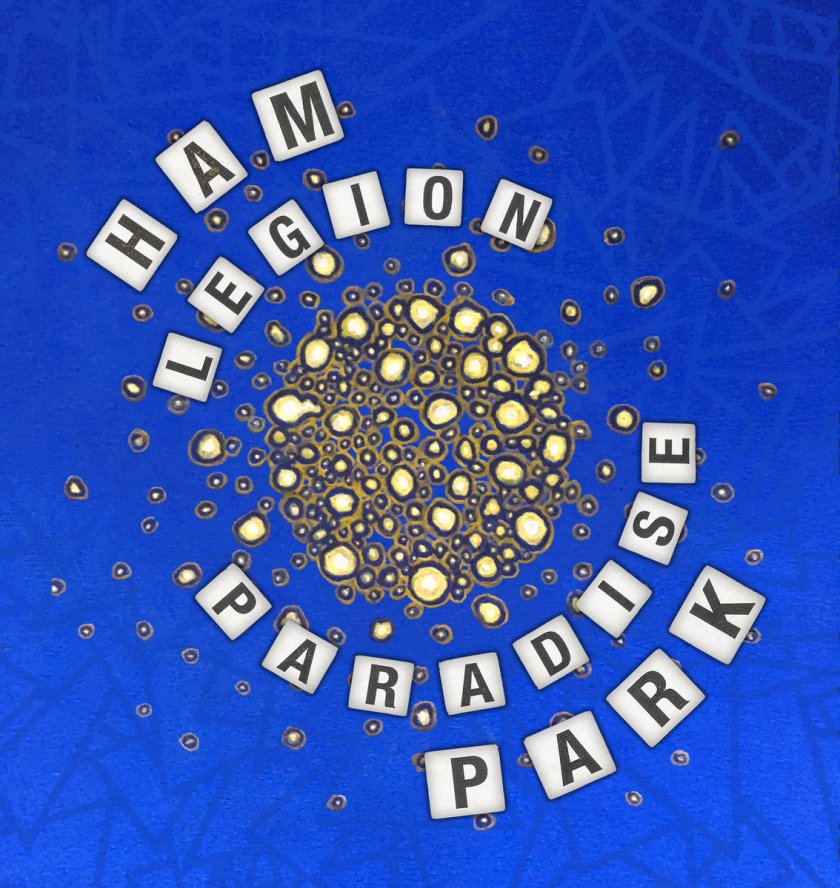
Ham Legion - Paradise Park

As a rule, I don’t like guitar albums, particularly if they are full of power chords or metally, growly things; but that is just because they don’t make them like ‘Paradise Park’ the debut album by Ham Legion. This album contains all of the above and remains heavy as a brick while avoiding empty shows of testosterone. And crucially, it also simultaneously dares to be light as a butterfly.

The effect is stunning; and I mean that in a literal and visceral way. In order to hear what goes on in the subdued and near-silent parts, you can’t help but turning up the volume knob – then, when the guitars thunder and the screams rip, your mind is blown and your head is physically smashed against the wall if you pull back too fast.

At the beginning of the year, I boldly announced that the Lost Crowns debut album ‘Every Night Something Happens’ was the album of the year. I knew that was a dangerous thing to do, but I couldn’t in my wildest fantasies imagine an album like this coming along. Now, this isn’t a competition and there is no need to announce a winner. Suffice to say is that if you liked that album you will love this. And there is a connection between them in the form of legendary pronk band Cardiacs: ‘Paradise Park’ has been mastered by Mark Cawthra, and William D. Drake plays keyboards on one of the tracks. (Cawthra was the original drummer in Cardiac Arrest, and Drake was in the classic era Cardiacs lineup.)

If anything, this is much more in pronk territory than the Lost Crowns. Come to think of it, this is much more progressive rock than the stuff they write about in Prog Magazine; there is no set evolution for the tracks here. On the contrary, they often seem to be made up of discarded bits and pieces of failed attempts at songwriting that are just haphazardly strung together. On paper that obviously doesn’t work, but somehow Ham Legion turn these impossible collisions of ideas and styles into journeys of discovery. As a listener you feel a strong urge to go a long for the ride to see where it all goes. Invariably, it goes off the chart, and sometimes off a steep cliff into empty space as well. But it certainly is thrilling.

Take for example the track ‘(I Would Like To Have Significantly Larger) Portions (Please)’; the title itself conjures up bits and pieces of leftovers that have been scraped from their plates and left in a big ugly pile. And that sums it up rather well. The track fades in gently with a distorted, sustained guitar tone that is then taken over by a basic heavy rock riff lumbering on until it via a finger picked bass segues into a more energetic metal beat topped by a death growley vocal. However, soon the noise disappears and there is a lone and bedroom singer-songwriter a line about something “so early in the morning”. 

Here is where you start dialling up the volume in order to hear what he is singing about… But just as you lean into the speaker, the frail vocal is replaced with a big Queen-like hard rock chorus, that then exchanges a few passes with the muted vocalist before you are carried away on a stretch of guitar rock into the sunshine. Like I said, it doesn’t work on paper!

If those where the leftovers, then ‘Oooodles’ plays like its diametrical opposite; here we get all the bits and pieces of good ideas that were saved in order to be expanded into full pieces later on. Unfortunately that never happened, and by the way the good ideas were not as plentiful, hence the track is only half as long as ‘Portions’. 

That is not to say that there are moments of exquisite beauty here. Take the first minute of ‘Moths Bugs & Bees’ for example, which is back to the bedroom poet’s frail and contemplative pop. Until the track is taken over by satanic screams, that is…

There are also more traditional song structures, proving that Ham Legion indeed are quite capable of writing catchy pop thingies if they wish, such as on ‘Curse the Weather’. Although the instrumentation is a bit wonky, the tune does have identifiable verse and chorus parts and would be a given hit in an alternative universe where good music means as much as good marketing budgets.

But picking out tracks like this doesn’t do the album justice. It is not only that there isn’t a duff moment here, but also that the tracks taken together become bigger than their sum. Simply brilliant!

Roger Heathers makes acoustic harmony pop album

Roger Heathers - Grim

After having released mini album ‘Next Week In Münster’ back in May, Roger Heathers is back again with another mini album, ‘Grim’. Looking at the cover, my first thought was that this might be a Halloween record, but more than anything it is a set of love songs that don’t seem thematically tied to the grim reaper who has fallen asleep in an armchair on the cover. Maybe the point is that we are free to go on with our lives and loves as long as he is asleep? I am probably missing something obvious…

Whereas the previous album was a heavily arranged and intricate sounding 10CCesque affair, this is a quite stripped down set with acoustic guitar and vocals in the fore, as well as additional voices in the back. In fact, rather than calling this acoustic as Heathers does, I’d go as far as to call this a vocal extravaganza with lots of multi-tracked voices all over the place, both in fore- and background.

Unashamed harmony pop, then, quite beautiful yet thankfully without any cloying sweetness – but grim? No, not at all!

The songwriting remains as creative as on the previous album, although the songs come across as less complex mainly due to the use of fewer instruments. There aren’t even drums here… But despite intricate twists and turns in the melodies, it all seems unforced and the songwriting seems inspired.

It all makes for a very enjoyable listen. I particularly like the autumnal and somewhat brooding intro song ‘Reverie’. Then there is ‘Magic Happens’ which adds a welcome bit of piano, and ‘Untitled #2’ with its propulsive rhythmic drive despite the lack of drums.

As on previous offerings, it is quite difficult not to be charmed by the energy and musical enthusiasm on offer. At the same time, you get a strong feeling that there is still a lot of untapped potential, and that Heathers is still just playing around and trying stuff out, while feeling his way towards something much more substantial. So, although this is a very good little album in its own right, it also raises expectations of what he will do next. With all the talent on display here as well as on the May release, I am expecting big things ahead. 

Psychedelic pop perfection from West Coast wunderkind Curt Boettcher

7f92357f-05e7-45ab-bef1-8b98c482b85e-2

There is an easy way to sum up the ‘Looking For the Sun’ compilation featuring acts produced by Curt Boettcher: Perfection.

That perfection is fully expressed already on one of the earliest tracks on this compilation, ‘Milk and Honey’, recorded during two sessions, in December 1965 and January 1966, by one of Curt Boettcher’s own project’s, Summer’s Children, formed together with Victoria Winston. On the track, we are invited into a paradisiacal world where lovers live forever. The tracks starts with these lines:

“In the land of milk and honey; everything is fine there

In the land of milk and honey; water tastes like wine there”

Not only is the perspective in the lyrics one of absolute perfection; vocal and instrumental performances are top notch as well as are the tasteful production and sumptuous melody. The fact that it was recorded in Los Angeles and combines obvious religious references with a psychedelic undertone, makes it difficult not to start thinking about teenage symphonies to God when listening. 

And indeed: Allegedly, in the summer of 1966 while working at a movie soundtrack at Studio Three Western, Brian Wilson overheard Curt Boettcher working on Lee Mallory’s ‘That’s the Way it’s Gonna Be’ and was incredibly impressed with what he heard. Or maybe impressed is an understatement. This might in fact have been a turning point for Brian Wilson; one where he heard the future of sound.

Listening to this compilation, it is easy to understand why. The groundbreaking work Boettcher did on that classic Lee Mallory track is not included here (although it is available on the Rev-Ola Lee Mallory reissue among other places), but it isn’t even missed. Neither does it feature tracks like ‘Sweet Pea’ and ‘Hooray For Hazel’ with Tommy Roe or ‘Along Comes Mary’ and ‘Cherish’ by the Association – all Boettcher produced hits from the summer of 1966.

Nevertheless, the more obscure sounds conjured up by Boettcher for various artists that are included here – many of them for the first time on an official release – effortlessly stand their own ground and are seriously cutting edge.

A lot of bands would kill to sound like this today, yet this was recorded back in the 1965 to 1968 timeframe.

Not only do we get backwards sounds and multi-layered vocals, we are also treated to incredible orchestral arrangements, as well as solo instruments that are silhouetted in stark contrast from the crowded production as if they were all alone in the universe.

These recordings may have been made in some of the best LA studios at the time, with the best session musicians and orchestras, but judging from other recordings from the era, musical skills were a dime a dozen at that specific time and place. What really makes the difference here is a person with a singular vision who knew exactly what he wanted; and that is of course Curt Boettcher. 

At the point of his untimely passing at the age of 43, he was all but forgotten, but with a reissue campaign starting with ‘Begin’ by his band the Millenium in 1990, just three years after his death, he has been reinstated as one of the key figures of the West Coast 60s pop scene. And rightly so. It is extremely sad that Boettcher himself never got to know about this.

That bittersweet sadness is also aptly conveyed on the Gordon Alexander track that lends its title to the compilation, ‘Looking For The Sun’. The song starts like this:

“I went looking for the sun, in the darkness of my mind

But I knew right along

It was your touch and gentle smile that made the world seem fine

Come on back where you belong

Beer came splashing into my mouth, I got drunk and I felt alone

I went looking for me

The covers of the night came dimming my eyes, it felt like dry white bone

Without your eyes I can’t see”

With altogether three tracks, Alexander is also the artist most prominently represented here. That makes a lot of sense, given that he is also one of the casualties of the music business: His sole album ‘Gordon’s Buster’ literally busted and sank without trace. It has never been properly reissued until this day, although a bootleg does exist.

But despite its perfection, this compilation is not perfect. As much of an anglophile as I may be, I have to confess that the one track I definitely can live without here is the one with an English singer, namely Jonathan Moore. A comedian who with ‘London Bridge’ tries to update the old nursery rhyme since the bridge at this point in time was actually sinking rather than falling down. However, set in this context, the attempt at being tongue-in-cheek just feels cheap and unnecessary. 

But that one missed opportunity can be forgiven in light of the supreme tastefulness that shines through everything else here. And luckily, even the flipside of Moore’s 1965 single, also included here, ‘I Didn’t Ever Know’ is much more passable.

If there is one track that stands out as much in the other direction, then that would have to be ‘Shadows and Reflexions’. Included on Fading Yellow volume 3, it appears here for the first time ever as an official reissue.: a complete miniature pop symphony that contains the kind of adventurous, genuinely American pop that Brian Wilson tried to position as an alternative to what the Beatles were doing. It would have been a highlight even on ‘SMiLE’ had it appeared back in 1967. This track alone is easily worth the price of this absolutely must have collection.

Oh, and the collection aptly ends with the Gary Usher-penned and raga-styled instrumental mini-extravaganza ‘Pisces’, a track that has only seen previous physical reissue on the Japanese CD version of the Sagittarius album ‘Present Tense’.