

Brilliant art pop band The Great Crash recorded around 45 high quality demos in a derelict South Wales barn between 1972 and 1975. Those demos are now surfacing. Michael Björn talks to Al Gray and Nick Smith about their fantastic second archival release, Too Many Late Nights.

In 1970, Alan Gray, drummer Piers Geddes and some friends made a privately pressed concept album called Bertie. “It was a joke. Tommy had just come out. I thought it was a load of rubbish, so I thought I’d do my own,” says Al. “We sent a copy to John Peel, just for a laugh. But he liked it and actually replied.”
Meanwhile Nick Smith and George Benn were performing as an acoustic duo. “We were all in Southampton University,” says Al. “They were playing gigs at the university, and said ‘Why don’t we join up?’”
Initially calling themselves Springheel Jack, they recorded a good handful of acoustic tracks at IBC studios in London produced by Damon Lyon-Shaw. Unfortunately, the acetate has since been lost. Shortly after, they auditioned for Shel Talmy. Arriving early, they had a pint at a nearby pub, where out of nowhere someone slugged Piers on the nose. “There we were in Talmy’s office, with blood pouring out of Piers’ nose,” comments Nick. “Probably blew our chances.”

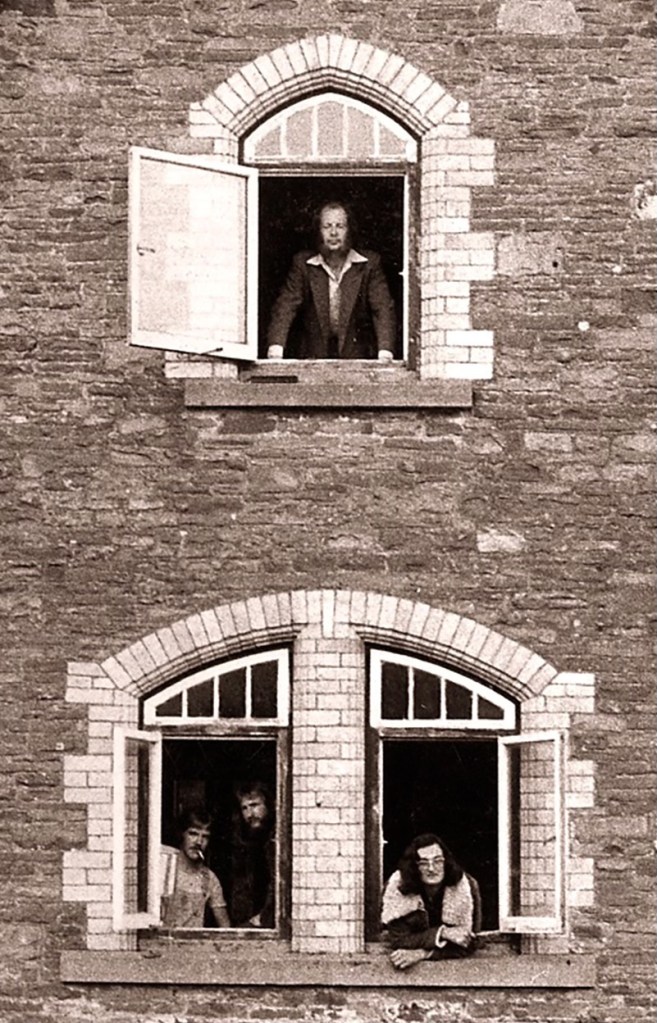
Having had a little success as an acoustic group, they decided to try going electric. Piers had found out that a relative of his had the remains of an unused, run-down country mansion, Plas Llecha, in Monmouthshire, South Wales with a barn where they could set up equipment and practice, so they decided to check it out.
“We had two extra members at that point,” remembers Al. “But when their girlfriends came down to visit, they were horrified at the living conditions, grabbed them by the scruff of their necks and took them home.” For the remaining foursome the week turned into a month and the month turned into a year. They ended up staying on for nearly three years, sustaining themselves on home-brewed beer and home-recorded music.
After having recorded a number of demos as the Great Crash in 1972, Al sent a tape to John Peel thinking Peel might remember him. ”He did, and he liked the demos,” says Al. Peel invited them to record a session for Sounds Of The Seventies. Sadly, the recording was far worse than their demos. ”We were the guinea pigs for the BBC’s new 8-track recording facility,” says Nick. ”They didn’t have a clue what they were doing.”

Although the session was aired twice, it lead to nothing. “Our our manager was always on the verge of getting us that elusive deal,” says Nick “When it finally happened, it was a complete disaster.” In 1974 they finally signed an album contract with Polygram. The producer, Emil Zoghby, came to Wales for a week to rehearse before going to the studio. ”He brought with him a vial of liquid cannabis, which he encouraged us to dip our Players No. 6 cigarettes into,” remembers Al. “Obviously, the rehearsals were quite fun, but not very constructive”.
After several all too relaxed days at Plas Llecha together with Emil, they again met up for a week of recording at Polygram’s Bayswater studios. “By the time we got into the studio, they had no idea what they wanted us to do,” says Al. Still, they went through the process of recording an four tracks, and then went back home without having heard so much as even a rough mix.
“Polygram sent us the mixes a week or two later. They basically had put in everything, their kitchen sink was probably in there somewhere as well: Brass section, a couple of extra guitarists, everything, “ says Al. “Somewhere buried in the middle is our little band, you know? It was hopeless. They obviously had no idea.” As the person who had signed them had also left Polygram, the album wasn’t happening and at the end of 1974. Sadly, the whereabouts of the master tapes are unknown.
And even more sadly — the failed record contract spelled the end of the band.
But — in 2003, Nick and bass player George got together, dug out all the surviving Plas Llecha demo tapes and digitalised the lot. A first compilation was eventually released on Seelie Court in 2021 as Deadfire Echoes, and now comes an even better collection, Too Many Late Nights, focusing mainly on their later and more complex material.
While initially having been two songwriting teams, Nick and George on the one hand, with Al and Piers on the other, songs were mainly written by Al and Piers during their years in Plas Llecha. Piers came up with lyrics and Al composed the music. George did write some pieces as well, but Nick focused more on turning their barn into a serviceable studio environment. The sound quality coming from their simple recording equipment in that damp and dilapidated barn speaks volumes of his ingenuity. “The backing tracks had to be recorded in one take. We couldn’t edit them together,” explains Nick. “If anybody fucked up, start again.”
Nick also carried some home-grown inventiveness over to his guitar playing and used broken milk machines littering the barn to build a phaser. “Nick took a motor out of one of them, mounted it on his amp so that an arm was fixed to the amp’s middle range fader,” explains Al. “When he clicked his foot, it came on and had this phasing effect. We used to get geeks peering up at it and asking him questions.”
But what truly sets the band apart is Piers’ awkward and hilarious lyrics. Very British in a Bonzo Doo-Dah Dog Band way, as on the track ‘Are You Hip To My Trip?’ Here, the protagonist is trying to sound more in tune with the times when smooth-talking women, because as the lyric states:
There’s not much you can do / if your love boat thinks you’re some kind of crank.
“One of Piers’ crazy ideas,” says Al. “It basically just gradually gets more and more crazy.” One certainly wonders what kind of woman would be flattered by the following:
You are the apple of my eye / you are the pear of my tongue / you are the orange of my thigh / you are the greengage of my lung / you are the rhubarb of my chest / you are the leek of my cheek / you are the cabbage of my bile duct.
Piers’ lyrics have stood the test of time incredibly well, but early 1970s listeners were puzzled by them. “Puzzled is a very generous interpretation!” exclaims Nick. “Trying to get a record deal, it drove us crazy. We asked Piers; ‘Just write some commercial lyrics!’” But whereas record executives might just shrug their heads and leave the room, playing in front of audiences in local rugby clubs and social clubs was challenging on a different scale. “We learned the lesson pretty quickly,” says Nick. “Covers were the thing pretty soon after that.”
Although ‘Hero Of The Beach’ is one of the few earlier demos on the album. The humour is already there. “That was one we did for John Peel,” says Al. “He thought it was going to be something about Sgt. Fury, on the beach on D-Day or something.” But instead it was a 50s styled sendup of boys trying to look macho on the beach, akin to ‘Sand In My Face’ by the 10cc.
But it wasn’t just the lyrics, the music could be pretty strange too, such as on one of their final demos, recorded in 1975. ‘Sidetrack Doubleback’ manages to subvert disco by being very rhythmical and catchy but also impossible to dance to, simultaneously fulfilling and obfuscating the point of that genre. “I was quite intrigued by disco, but I just couldn’t get it,” comments Nick “The drum patterns were so simple… we were used to more of a complication.” Yeah, you can say that again! Or you could think of another 10cc track, ‘The Sacro-Iliac’…
The last song is also the album’s title track. “Too many late nights and penny ices was an expression of my mother’s,” remembers Al. “If a child was throwing a wobbly, it was because they had been spoilt and had been staying up too late.” Listening to the embarrassment of riches almost overcrowding this album, it is easy to feel spoilt and to stay up late for repeat listens. But the fact that these demos were never turned into a proper album back in the day, where it would have sat comfortably with albums from bands like the 10cc or Stackridge, is certainly something to throw a wobbly over.
Or maybe not? It seems that the band members are at least reconciled with their past. “I think we all see it as a sort of a failure,” says Nick. “But we went our own way and did what we wanted to do. So I suppose we were very lucky.” Al points out that the success rate in the music industry is very low. “And the people who have been financially successful, have usually killed themselves with drugs — or coming off the drugs has killed them,” he concludes. “So I think failure has been our success.”
Too Many Late Nights by the Great Crash is out now on Seelie Court.

 Popgruppen
One thought on “Successful failures”